
Tigbuy Spreadsheet shelves, read from price tag to fee base
Sixteen shelves of the product catalogue, each opening a page of finds you can order through Tigbuy. Below them: what a card price tells you about the charge, and how to get from a card to an order.
Sixteen shelves of the catalogue
 OuterwearCategory
 SneakersCategory
 JeansCategory
 HoodiesCategory
 T-shirtsCategory
 SweatpantsCategory
 WomenswearSearch results
 BagsCategory
 HatsCategory
 JewelleryCategory
 Sports jerseysCategory
 BeltsCategory
 EyewearCategory
 PerfumeCategory
 WatchesCategory
 ElectronicsCategory
Category cards open a catalogue category; the women’s card opens search results, because the catalogue sorts by product type rather than by who wears it.
What a Tigbuy Spreadsheet is, on this site
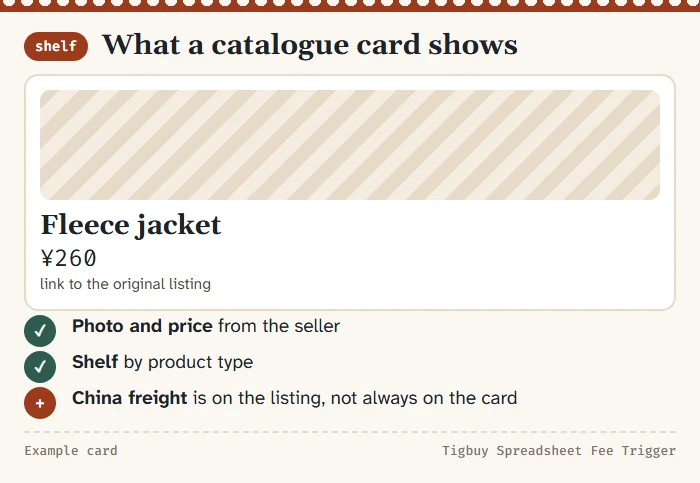
A spreadsheet in the shopping-agent sense is a catalogue: finds from Chinese shops arranged on shelves by product type, each card carrying a photo, an asking price and a link back to where the item is sold. You browse by category, open what looks right, and copy the listing link into Tigbuy to buy it.
The shelves above lead into that catalogue. This site adds one way of reading them: the price on a card is one part of the base Tigbuy uses for its service charge. The other part is the seller’s China freight, which the card does not always show.
Catalogue shelves are kept by people outside Tigbuy, and the same item can sit on several of them with prices taken on different days. That is one more reason to read the price and postage on the listing itself, through Tigbuy, before you count on a figure from a card.
The price on a card is half of the base
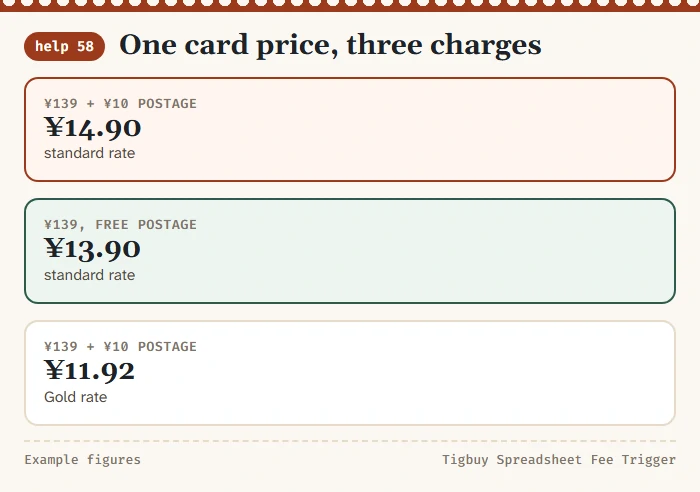
Take a card showing ¥139. If the shop charges ¥10 to post it to the warehouse, the base is ¥149 and the standard service charge is ¥14.90; at the Gold rate it is ¥11.92. If the shop posts for free, the base is ¥139 and the charge ¥13.90.
Card prices are snapshots. Sellers change prices, and colours or sizes are often priced differently from the one shown. The price that counts is the one on the listing when you submit the order to buy on Tigbuy, together with the postage the listing shows that day.
A useful habit when you shortlist finds is to write each one down as a pair, price and postage, instead of a single number. The pair is what Tigbuy uses. When several items come from one seller, note that as well, because buying them together lets the postage count once (help 62) and the base shrinks before any percentage is applied.
How the charge follows price on each shelf
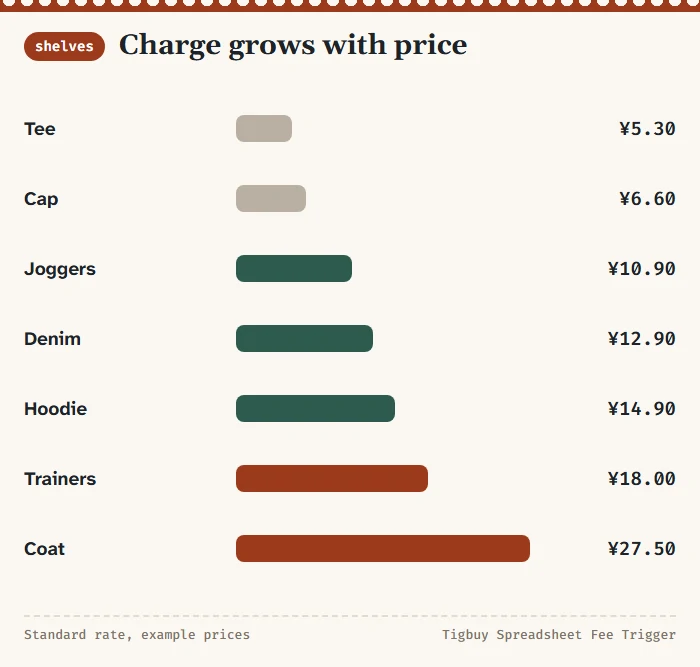
For an accepted standard purchase, the service-charge formula uses the price base. Item restrictions and separately selected services still need checking. A rough feel for each shelf at the standard rate, using round example prices:
| Shelf | Example price + postage | Standard charge |
|---|---|---|
| Everyday tees | ¥45 + ¥8 | ¥5.30 |
| Caps and beanies | ¥58 + ¥8 | ¥6.60 |
| Joggers and track pants | ¥99 + ¥10 | ¥10.90 |
| Denim | ¥119 + ¥10 | ¥12.90 |
| Zip and pullover hoodies | ¥139 + ¥10 | ¥14.90 |
| Trainers | ¥168 + ¥12 | ¥18.00 |
| Coats and jackets | ¥260 + ¥15 | ¥27.50 |
The examples are invented to show scale, not typical prices for any shelf. Real listings vary widely.
Search words that work on the catalogue
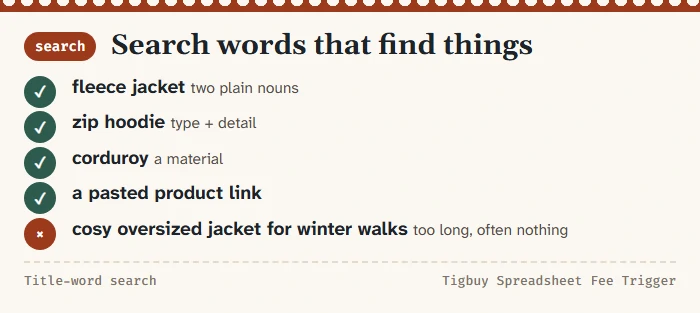
The home page’s search field looks through this same catalogue. It matches words in listing titles, so short, plain nouns work better than long phrases:
- use one or two words: “fleece jacket”, “zip hoodie”, “pocket tee”;
- add a material or a cut rather than an adjective: “corduroy”, “wide leg”;
- paste a product link if you already have one;
- if a search returns nothing, drop a word rather than adding one.
From a card to a Tigbuy order
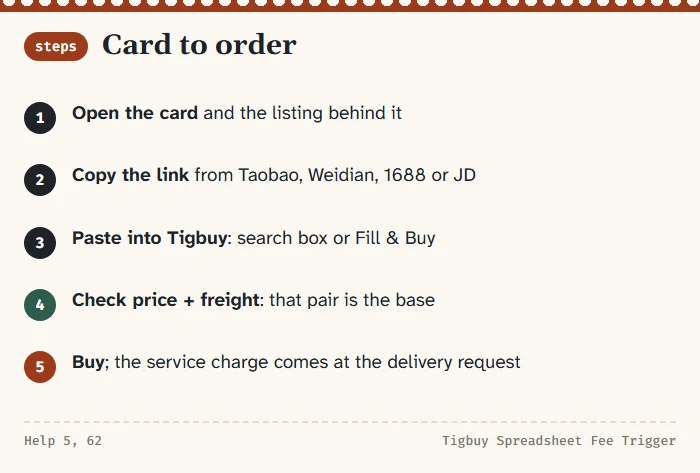
- Open the card and the listing behind it.
- Copy the Taobao, Weidian, 1688 or JD link.
- Paste it into Tigbuy’s search box, or into Fill & Buy with the price and postage.
- Check the price and China freight Tigbuy shows; that pair is your base.
- Buy it. The service charge comes later, at the delivery request.
If several finds come from the same shop, buy them in one go so Tigbuy can combine the domestic freight (help 62).
Keep the listing link with the order. If the price on Tigbuy differs from the card, trust the listing, and the link is what support will ask for if something goes wrong later.
Carry the exact option into the buying request
Choose the product variant on the seller’s page before copying the link. Record its colour, size, quantity and relevant measurements, then check whether the selected option changes the displayed price. A reused photograph or a matching product name does not prove that two sellers supply the same item. Save the description you relied on alongside the agent order.
The Spreadsheet helps with discovery; Tigbuy performs the purchase and warehouse service. A catalogue amount is neither a stock reservation nor a final delivered price. Confirm the product and applicable domestic charges at purchase, and keep a separate allowance for the international parcel. The fee base explained here belongs to a particular charge, not to every cost in the shopping journey.